top of page

10 Plays from the Will Wade Offense

While debates will rage about the first season of Will Wade at NC State, many of which may hinge on what happens in the tournament, there is no denying that Wade's first offense was a potent product. At the time of this writing (ahead of the Texas matchup in the NCAA Tournament), NC State has a top 20 offense that ranks 36th in effective field goal percentage and is still top 10 in three-point percentage.


Despite some unexpected shifts in the value of specific players, this group did an excellent job putting pressure on the rim, moving the ball, making shots, and finding ways to use its shooters. Jump into the offense with us as we look at 10 sets from the 2025-26 season.


Ram Pick and Roll


Quadir Copeland was State's main pick and roll guy, and Wade had a lot of different way to get to and to run various pick and roll sets. We can't cover all of them, but let's start here, with the ram action. Ram is a common action across all of basketball. The ram screen can delay the big's arrival at the ball screen, which can impactful against defenses that want to hedge or switch ball screens.


Paul McNeil sets a down screen (or ram screen) for Lubin.
Lubin then sprints up and sets the ball screen for Copeland while McNeil clears to the corner. In some instances, State would run what is called "ram exit," where McNeil would use and exit screen to clear to the corner. In this case, Williams is on the opposite block and State will add a replace component to the action. More on the replace component below.


Roll-Replace


Roll-replace is a common response to hedging defenses that helped State beat SMU. Darrion Williams hit multiple timely threes out of this action in a game that may have decided State's tournament fate. The fundamental theory is a simple one of just relocating the player that the defense will help off of in order to tag the roller.


It starts with a simple ball screen action with Darrion Williams at the elbow area or lower.
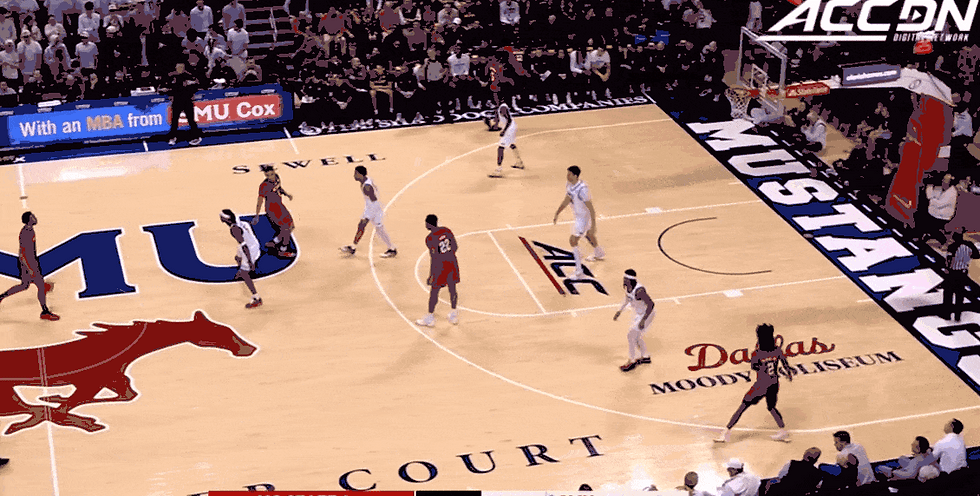
SMU's big steps out to hedge the ball screen. The big will then recover to Lubin and the original on-ball defender will recover to the ball. To prevent a wide-open Ven-Allen Lubin layup, SMU has to rotate off one of the shooters to pick him up in the lane, known as the "tag." Roll-replace exploits this by taking the unguarded shooter and "replacing" the ball screen exchange point with him.
You can see the tag occur here and the big trying to recover. Williams is open on the wing as his defender must protect against the Lubin roll before recovering.


1-4 Pick and Pop


One of my favorite ways State used Darrion Williams was as a pick-and-pop player because of his shooting ability and his ability to flow into something else as a creator. State got some valuable buckets from this against actually good teams, but it had the most fun with it against UNC-Greensboro. I covered this one in our Trinity Road Tape series.


1-2 Ghost


Maybe the most used action of the year for Will Wade, this was a staple down the stretch and an extremely productive set. It created space for Copeland to operate and the potential to get a three from the ghost screen if the defense did not carry it cleanly. It can also create a positive matchup if teams decide to switch the guard-to-guard screen. State would run this with both Able and McNeil.


Arceneaux clears to the opposite corner while Able sprints to set a ball screen.
Able "ghosts" the ball screen to the wing. On occasion, you would see him actually set the screen and then the play would proceed the same way.
Copeland now has a "double gap" he can attack off the dribble, allowing him space to create a paint touch and score or pass out of it. Williams in the corner makes it hard to help off the strong side. It's a simple principle of making space for an elite creator in Copeland.


Veer


One of the most used accompaniments to State's pick and rolls was the veer action, which was ran a lot for McNeil. It gave the appearance of a basic spread pick and roll but then used what's called a veer screen to get McNeil an open look from the top of the key.


This can initiate different ways. In this example, McNeil gives Copeland a brush screen before clearing to the weak side wing.
Ebube sets the ball screen for Copeland with McNeil occupying the weak wing and two shooters in the corners, the classic spread pick and roll look.
Instead of rolling to the rim, Ebube will set the veer screen for McNeil, who will use it to come back to the ball. Copeland is not looking to attack the rim here, and will instead look to pass back to McNeil.


Twirl


Twirl is a three-man action that State used to get a shot for Paul McNeil, run out of its gaggle alignment, which it would also use to initiate pick and roll for Copeland. The defining characteristic is the three players to one side and various screening actions that can come out of that.

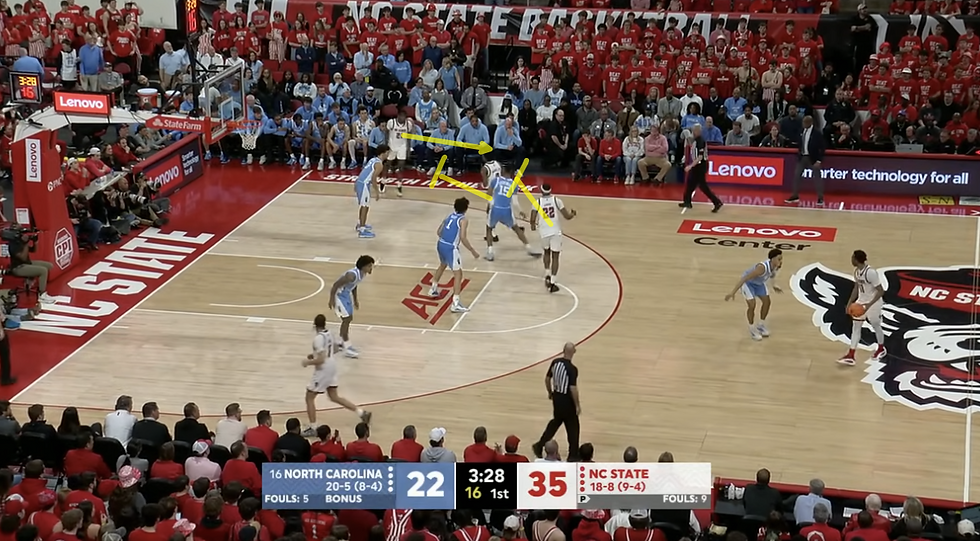
Here is your gaggle with Arceneaux, McNeil, and Lubin
McNeil and Lubin act like they are going to set staggered wide pin down screens for Arceneaux.
Arceneaux cuts to the basket between the screens. State can steal two points from this if it's not picked up.
McNeil then uses Lubin's wide pin to come back to the ball for a three. Lubin's man may sink to protect against the basket cut from Arceneaux, which affects the toolbox the defense can use to defend the screen for McNeil.


Triple Screen


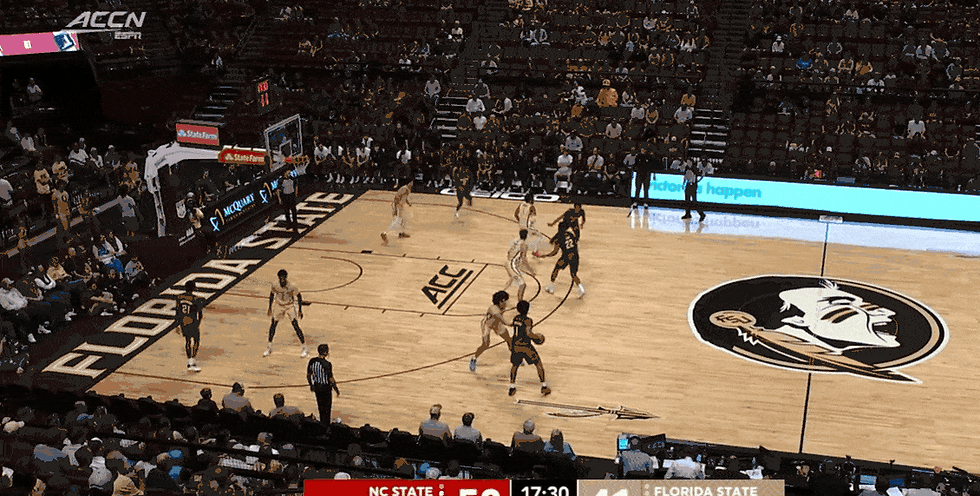
An occasionally used set against the 2-3 zone, triple screen is a flare screening action for Paul McNeil. State hit this against Florida State in the example below. It notably called it at the end of the Notre Dame game, but could not get the shot to go in.


McNeil passes the ball to the wing.
State will flare screen both of the two players at the top of the 2-3 zone while Breed will pin down the corner player.
This is what you end up with. State wants to create space for McNeil to get a shot off in the slot area.


Darrion Williams Post-Ups


State's primary creators were Copeland and Williams, and most of the actions ran for Williams, especially later in the year, were through the post. These were ran in various ways, with two examples below.


The first is this simple down screen seal, very similar to how Kevin Keatts played through DJ Burns, which would also feature flare screening for shooters on the perimeter.


Williams sets a down screen for Able.
Williams will then flip and seal as the ball comes to Able. McNeil will clear to the corner. Once the ball goes into Williams, Able will sprint to the opposite corner, Lubin will relocate to the dunker spot, and Copeland can flare screen for McNeil. It plays out from there with Williams backing down his man and scoring or passing out of it.

Second is this take on the veer action discussed above.


This initiates with a pass to Copeland who gets an initiation screen. McNeil then runs to set a back screen for Williams.
Williams uses the screen to relocate to the opposite post. Lubin flips and Copeland uses his ball screen.
Williams will post up his man, while Lubin sets the veer screen for McNeil. Copeland can go either place with the ball. In this example, FSU bungles the switch on the back screen and McNeil comes wide open.


V Cross


V cross is a 2-3 zone beater that State used to get Darrion Williams an easy layup a few different times this year. Its key elements are the 45 cut and then clear (V cut) to occupy the corner and the cross screen to utilize the space the V cut creates. I covered this one in our Trinity Road Tape series.


If you enjoy this kind of analysis, join Trinity Road Times for free and receive emails whenever new content is published.


Also check out the Trinity Road Times Member Chat, our premium message board that costs just $3 a month and includes all sorts of additional features.


bottom of page