top of page

Three Plays with Will Wade: Screening for Paul McNeil

One of the more fun components of the Will Wade offense is the use of Paul McNeil. As we discussed on this week's Lotcast episode, McNeil is a getting a lot of volume simply from being around Quadir Copeland, and his gravity as a floor spacer creates tons of conflict for defenses. That's not the only way he gets shots, though. Today, we're looking at three set pieces that led to Paul McNeil triples.


Veer

A veer screen is an off-ball screen set by a player who has just set a ball screen. This is one of Wade's go-to ways to get McNeil shots. Let's start with the more basic of it.


It starts with a touch action. Copeland passes to McNeil who hands it back to Copeland. This will play right into a ball screen as McNeil clears to the wing.
Ebube sets the ball screen for Copeland, but instead of looking to attack, Copeland will look to return the ball to McNeil as the core of the veer action takes place, which you will see below.
After the ball screen, Ebube clears toward McNeil and sets the veer screen. Copeland returns the ball to McNeil as McNeil comes off the veer screen looking to shoot.
McNeil's defender chases over the veer screen and McNeil gets enough space off it to get the shot up cleanly. We'll never know if he called bank.

Screen-the-Screener Veer

Here, Wade gets Darrion Williams involved as State runs a similar play, but with an option component for Copeland.


Lubin sets the initiation screen for Copeland as Williams gives him the ball. McNeil will begin his cut to the opposite wing.
Lubin will flip and set a ball screen for Copeland. McNeil will set a back screen for Williams
Williams will use the screen's leverage to post up his defender on the opposite block. Lubin, after setting the ball screen, will then set the veer screen for McNeil. Copeland can now deliver the ball to either player.
Florida State soft hedges the ball screen and attempts to switch the back screen. They don't communicate the switch well. The switch onto Williams eliminates the post up, but the switch onto McNeil is super late and McNeil's defender ends up way behind him as he lifts to accept the veer screen. The result is an easy shot.

Triple Screen

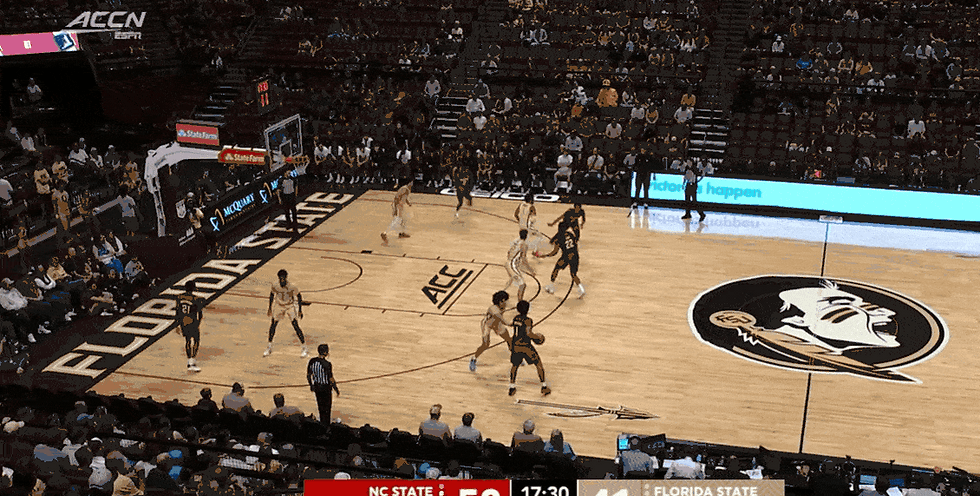
Florida State briefly went to a 2-3 zone against State, something that was quickly taken apart by actions like the one below. How a coach uses ball screens and off-ball screens against a zone is always one of the more interesting schematic points. Wade has shown some fun stuff so far. Let's look at the triple screen action.


McNeil passes to Williams on the wing to start the sequence
Sagnia and Lubin will each set a flare screen on the two players at the top of the 2-3 zone. Breed will pin down the corner.
State has essentially screen an entire side of the floor for McNeil who can run off the flare screen, catch, and do the thing he does where he makes the ball go in.
The Noles offer little resistance on Breed and Lubin's screens.

If you enjoy this kind of analysis, join Trinity Road Times for free and receive emails whenever new content is published.


Also check out the Trinity Road Times Member Chat, our premium message board that costs just $3 a month and includes all sorts of additional features.


bottom of page